The bushing for cars is an essential component in various mechanical systems, as it reduces wear and ensures the proper functioning of parts.
This component is frequently used in vehicles in areas subject to stress, vibration, and continuous movement.
In this article, learn what a bushing is, what it is used for, the existing types, and how to choose the right model for each application.
What Is a Bushing?
A bushing is a cylindrical component that acts as a support element between two moving parts.
In practice, it allows sliding between surfaces, reducing friction and wear.
Unlike more complex systems, a bushing does not use balls or internal rolling elements.
What Is The Purpose Of a Bushing?
The main function of this component is to reduce friction between moving parts, as it:
● Facilitates sliding between components;
● Absorbs vibrations and impacts;
● Reduces wear on parts;
● Protects shafts and housings;
● Improves system durability.

What Are The Main Types Of Bushings?
There are several types of bushings, adapted to different working conditions and mechanical applications.
Among the most common are:
1. Metal Bushings
These are the most robust and suitable for applications with high loads and constant stress, as they have high mechanical strength.
In practice, they are used in:
● Suspension arms;
● Stabilizer bars;
● Drive shafts;
● Chassis supports;
● Front and rear suspension joints.
2. Self-Lubricating Bushings
These incorporate materials that reduce friction without the need for constant lubrication, making them ideal for hard-to-reach areas or where maintenance is limited.
In practice, they are common in:
● Steering column (internal joints);
● Clutch and brake pedals;
● Gearbox mechanisms;
● Control linkages (levers).
3. Polymer Bushings
Made from synthetic materials, they are lightweight and corrosion-resistant.
They are typically used in:
● Radiator mounts;
● Fan supports;
● Seat adjustment mechanisms;
● Interior components and structural plastics.
4. Coated Bushings
These have an additional layer that improves sliding and reduces wear, making them ideal for applications where friction must be minimized.
They are used in:
● Drive shafts;
● Suspension arms with constant movement;
● Steering components (rack);
● Joints subject to continuous wear.
Is a Bushing The Same As a Bearing?
The main difference lies in the type of movement and how friction is reduced, as they are two completely different components.
See the differences in the comparison table below:
| Feature | Bushing | Bearing |
| Type of movement | Sliding | Rotation with balls or rollers |
| Friction level | Higher | Lower |
| Structure | Simple | More complex |
| Impact resistance | High | Medium |
| Maintenance | Low | May require lubrication |
| Noise | Quieter | May require lubrication |
| Cost | More economical | More expensive |
| Applications | Suspensions, supports, and joints | Wheels, engines, and rotating shafts |
What Are The Advantages Of Bushings Compared To Ball Bearings?
Despite being simpler, bushings offer:
● Greater impact resistance;
● Better performance in dirty environments;
● Lower maintenance requirements;
● Quieter operation;
● Lower cost.
Therefore, they are ideal for applications where robustness is more important than speed.
How To Identify The Best Types And Models Of Bushings?
In practice, a good bushing should have:
● Proper fit to the shaft;
● Material suitable for the application;
● Good wear resistance;
● System compatibility.

What Are The Most Common Mistakes When Choosing a Bushing?
Choosing the wrong bushing can compromise the entire system where it is applied, so avoid:
1. Choosing The Wrong Material
Not all bushings respond the same way to load, temperature, or environment. The wrong material can wear quickly or fail prematurely.
2. Ignoring Tolerances And Dimensions
A poorly fitted bushing can create clearance or excessive tightness, affecting performance and accelerating wear.
3. Not Considering Load And Stress Type
High loads, vibration, or constant movements require specific solutions. Ignoring this reduces durability.
4. Neglecting Lubrication (When Required)
Some bushings need regular lubrication. Without it, friction increases and wear accelerates
5. Incorrect Installation
Improper installation can damage the bushing from the start, so alignment and force application must be handled carefully.
What Bearing And Bushing Removal/Installation Kits Are Available In The Kroftools Catalog?
KROFtools offers solutions for installing and removing bushings, simplifying work in the auto repair shop.
See which models are available in our catalog:
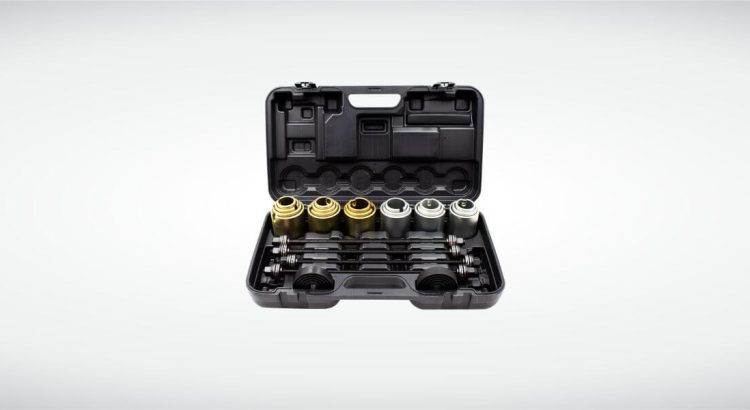
1. Bearing Bush Removal/Insertion Kit 26pcs

This kit, composed of various adapters, allows the removal and installation of bearings and bushings of different sizes.
In practice, it is a versatile solution for general workshop tasks, ensuring even force application and reducing the risk of component damage.
Click the image for more information about the Bearing Bush Removal/Insertion Kit 26pcs (ref. 6315).
2. Hydraulic Bearing Bush Removal / Insertion Kit 63pcs

This complete hydraulic system kit was developed for more demanding applications and hard-to-remove bearings or bushings.
In practical terms, it allows more force to be applied with less effort, ensuring faster and more controlled extractions.
Click the image for more information about the Hydraulic Bearing Bush Removal / Insertion Kit 63pcs (ref. 6329).
3. Trailing Arm Bush Tool Ford/Volvo

This is a specific tool for removing and installing bushings in suspension arms of Ford vehicles and some Volvo models.
In practice, it allows work directly on the vehicle without removing the arm, significantly reducing intervention time.
Click the image for more information about the Trailing Arm Bush Tool Ford/Volvo (ref. 6310).
How To Increase The Service Life Of A Mechanical Bushing?
Durability depends on use and maintenance, so make sure to:
● Ensure correct installation of the bushing;
● Use proper lubrication;
● Avoid overloads;
● Regularly check for wear;
● Replace when necessary.
Want to learn more about the automotive world? Follow us on Facebook and stay updated with all the content we share daily.

