Runflat tyres are becoming increasingly common on modern vehicles, presenting a real challenge for any automotive workshop that does not have the right equipment.
Their reinforced structure requires specific tools, as a conventional tyre changer does not have sufficient force or geometry to handle them without risking damage to the tyre structure.
In this article, discover what a runflat tyre is and what solutions are available to equip your workshop.
What Is a Runflat Tyre?
A runflat tyre allows you to continue driving after a loss of tyre pressure. Its sidewalls are reinforced with a rigid rubber layer that supports the weight of the vehicle even without air.
In the event of a puncture, the driver can continue driving at speeds of up to 80km/h for approximately 80km, without having to stop on the roadside to change the tyre.
How Does a Runflat Tyre Work?
The difference lies in the sidewalls. In a conventional tyre, the sidewalls are flexible and collapse when pressure drops. In a runflat tyre, the sidewalls have a rigid internal structure that maintains their shape even without air pressure. This is what makes mounting and removing them much more difficult.
Despite their features, runflat tyres have both advantages and disadvantages that should be considered.
What Are The Advantages Of Runflat Tyres?
The main advantages of this type of tyre include:
1. Safety In The Event Of a Puncture
With a conventional tyre, a puncture at high speed can result in an immediate loss of control. With a runflat tyre, the vehicle remains stable, allowing the driver to slow down in a controlled manner.
This means there is no need to stop on the roadside or replace the tyre in unsafe conditions.
2. No Need For a Spare Wheel
Vehicles fitted with runflat tyres do not require a spare wheel. This frees up luggage space, particularly in SUVs, and reduces the overall weight of the vehicle.
As a result, fuel consumption may be improved and the vehicle’s handling enhanced.
3. More Stable Driving
The rigid sidewalls reduce lateral tyre deformation when cornering, providing more direct steering response, especially at higher speeds.
This is one of the reasons why runflat tyres are commonly fitted to sports and premium vehicles.
4. Greater Peace Of Mind When Travelling
Knowing that a puncture does not require an immediate stop changes the driving experience, particularly on long journeys or in areas where roadside assistance is not readily available.
This gives the driver time to reach a workshop without compromising safety.

What Are The Disadvantages Of Runflat Tyres?
The main disadvantages of runflat tyres include:
- Higher price: a runflat tyre typically costs between 30% and 50% more than an equivalent conventional tyre;
- Reduced ride comfort: the stiffer sidewalls transmit more vibration into the cabin, especially on uneven road surfaces;
- Limited compatibility: they only work with wheels fitted with a Bead Seat Hump (BSH) system. They cannot be fitted to conventional rims;
- Require specialised equipment: mounting and removal require a tyre changer with a runflat assist arm, which not every workshop has.
What Is a Runflat Tyre Changer?
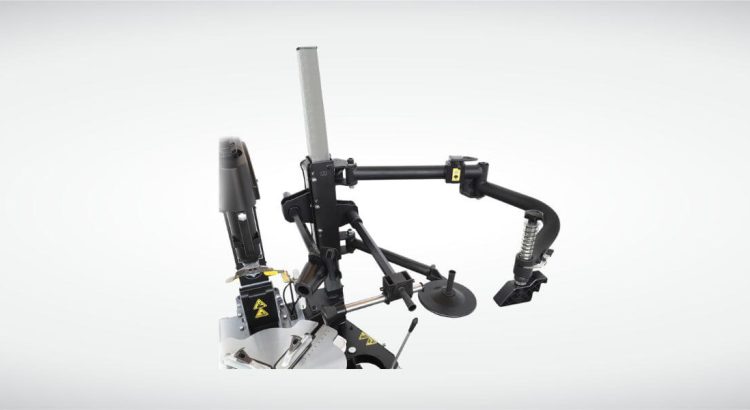
A runflat tyre changer is an automatic tyre mounting and demounting machine equipped with a dedicated auxiliary arm designed specifically for tyres with reinforced sidewalls.
The runflat arm applies pressure and guides the tyre bead during the operation, compensating for the additional resistance of runflat and low-profile tyres.
Without this equipment, removing a runflat tyre can damage the bead, scratch the rim or, in extreme cases, cause accidents due to sudden bead release.
How Does a Runflat Tyre Changer Work?
The process differs from conventional tyre removal in two key stages: bead breaking and tyre removal from the rim.
The runflat arm is positioned on the edge of the rim and applies controlled pressure to the tyre sidewall while the turntable rotates. This pressure guides the bead into the wheel’s drop centre, progressively overcoming the tyre’s structural rigidity without sudden impact.
The result is a safer removal process for both the tyre, the rim and the technician.
What Is The Purpose Of The Runflat Assist Arm?
The runflat assist arm performs three main functions during the operation:
- It applies controlled pressure to the tyre sidewall, replacing the technician’s manual effort;
- It guides the tyre bead into the wheel’s drop centre, making removal easier;
- It protects the rim from scratches and deformation during removal, especially alloy wheels.
Even with very low-profile tyres that are not runflat, the assist arm is highly recommended, as the reduced sidewall height leaves very little room for manoeuvre during the operation.

Which Models Are Available In The Kroftools Catalogue?
KROFtools offers two runflat assist arms for tyre changers, compatible with its automatic tyre mounting and demounting machines:
Runflat Arm For Tyre Changer

Professional auxiliary arm for mounting and removing runflat and low-profile tyres.
It attaches directly to the tyre changer frame and is compatible with 380V tyre changers.
Click on the image for more information about the Runflat Arm For Tyre Changer (ref. 9018).
Runflat Arm For Tyre Changer With Rotating Roller

Designed for workshops with a higher volume of runflat and high-performance tyre work.
Click on the image for more information about the Runflat Arm For Tyre Changer With Rotating Roller (ref. 9070).
Compatibility With Kroftools Tyre Changers
Both assist arms are compatible with the following KROFtools tyre changers:
Automatic Tyre Changer 380V (Ref. 9016): external clamping 12″-24″, internal clamping 14″-26″, maximum wheel diameter 1120 mm (44″), bead breaker force 2500 kg, power 1.1 kW;
Automatic Tyre Changer 380v 10”-24” (Ref. 9046): 380V three-phase power supply, wheel capacity 10″ to 24″, power 0.75/1.1 kW;
Automatic Tyre Changer 220v 10”-24” (Ref. 9047): 220V single-phase power supply, wheel capacity 10″ to 24″, power 0.75/1.1 kW.
For workshops that do not yet have a tyre changer, KROFtools also offers the Kit 9016+9018 (Ref. KIT90169018), which includes the automatic 380V tyre changer with the runflat assist arm.
How To Choose The Best Runflat Tyre Changer For Your Workshop?
Your choice depends on three factors:
- Workload: for intensive work with runflat and high-performance tyres, the rotating roller model (Ref. 9070) offers greater protection and efficiency;
- Available electrical supply: if the workshop does not have a three-phase power supply, Ref. 9047 (220V single-phase) is the compatible option;
- Wheel size: ensure the machine covers the range of wheel sizes commonly serviced in your workshop.
If your workshop already has a KROFtools automatic tyre changer, the runflat assist arm can be purchased separately and fitted to the existing machine.
What Is The Price Of a Runflat Tyre Changer?
As a general rule, the price of a runflat tyre changer ranges into the thousands of euros, depending on the model and capacity selected.
In addition, you may need to purchase the runflat assist arm separately, as it is not always included with the tyre changer.
Where Can You Buy a Runflat Tyre Changer?
You can purchase this equipment through an authorised KROFtools distributor.
Looking to learn more about workshop equipment? Follow us on Facebook and keep up to date with all the content we share every day.

