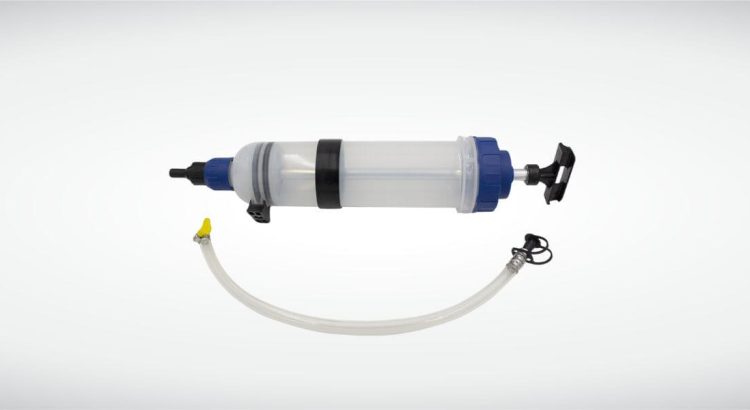
An oil syringe is a simple and effective tool for removing, transferring or dispensing fluids during automotive maintenance operations.
Available in any automotive repair workshop, this tool is essential for tasks where direct access to the reservoir is more difficult.
In this article, discover what an oil syringe is used for, how to use it and which models are available.
What Is An Oil Syringe?
An oil syringe is a cylindrical container with a plunger, made from plastic that is resistant to oils and solvents.
Unlike a standard medical syringe, an oil syringe has a much larger capacity. It is available in various capacities, from 200 cc to 1500 cc, and is compatible with a wide range of fluids.
In addition, the reinforced nozzle and specially selected materials withstand aggressive fluids such as transmission oil, brake fluid and coolant.
What Is It Used For?
This tool is used to remove and transfer fluids in hard-to-reach areas without the need for hoses, funnels or auxiliary containers.
Its most common applications include:
- Adding brake fluid to the reservoir;
- Extracting power steering oil or hydraulic clutch fluid;
- Removing transmission or differential oil through the level opening;
- Removing coolant from reservoirs for inspection or replacement;
- Transferring AdBlue into the SCR system tank.
Why Is An Oil Syringe Used In Automotive Maintenance?
In automotive maintenance, many tanks and reservoirs are located in areas where it is not possible to connect hoses or use wide-mouth funnels.
Since the syringe reaches places where other tools cannot, it makes it possible to collect fluid samples for analysis or top up fluid levels accurately while preventing spills that could contaminate other components.
It is also a hygienic tool. It keeps the fluid contained inside the cylinder and allows it to be transferred directly into a drain pan without contact with intermediate surfaces.
What Is The Difference Between An Oil Syringe, a Manual Pump And An Oil Extractor?
All three tools extract fluids, but they serve different purposes and have different capacities :
| Oil Syringe | Manual Pump | Oil Extractor | |
| Operation | Manual plunger | Lever or piston | Manual or pneumatic vacuum |
| Capacity | 200 cc to 1500cc | 1 to 5 litres | 5 to 20 litres |
| Purpose | Precise dosing and access to confined areas | Transfer of medium fluid volumes | Complete engine oil extraction |
| Used for | Oil, fluids and AdBlue | Oil and fuel | Mainly engine oil |
As a general rule, the syringe is the right choice for small volumes and precision work. For complete fluid removal, use an engine oil extractor. For transferring larger volumes, a manual oil transfer pump is more practical.
When Does It Make Sense To Use One?
It makes sense to use this tool in situations such as:
- Adding fluid in areas with limited working space;
- Topping up transmission oil without removing components;
- When the reservoir has no accessible drain plug;
- Taking a fluid sample to inspect its condition without emptying the reservoir;
- Transferring AdBlue without the risk of cross-contamination.

Which Fluids Can Be Used With An Oil Syringe?
An oil suction syringe can be used with:
- AdBlue;
- Coolant;
- Brake fluid;
- Transmission and differential oil.
What Are The Main Advantages?
Having an oil suction syringe in your workshop toolbox offers several benefits.
1. Greater Precision
The syringe dispenses fluid accurately thanks to the volume markings on the cylinder.
It transfers exactly the required amount, without overfilling, spills or waste.
2. Easier Access
The narrow nozzle fits into tight openings and reaches reservoirs where other tools cannot.
This accessibility is exactly what makes the syringe indispensable for many maintenance operations.
3. Cleaner Operation
The fluid remains contained inside the cylinder throughout the entire process.
There is no contact with intermediate surfaces, reducing the risk of contamination and keeping the work area clean.
4. Affordable Cost
It is one of the most affordable tools a workshop can own and one of the most cost-effective in terms of applications per euro invested.
It completes in seconds tasks that would otherwise require component removal or improvised solutions.

How To Use An Oil Syringe Step By Step
To get the best results, you should:
- Insert the syringe nozzle into the tank or reservoir opening;
- Slowly pull the plunger to draw in the fluid while monitoring the volume markings on the cylinder;
- Carefully remove the nozzle to avoid spills;
- Insert the nozzle into the destination container;
- Push the plunger to release the fluid in a controlled manner;
- After use, clean the syringe with a cloth. If necessary, rinse it with clean water or a compatible solvent before storing it.
Which Oil Syringe Models Are Available In The Kroftools Catalogue?
The KROFtools catalogue includes four models with different capacities to meet every requirement.
Learn more about each model below.
Syringe Oil 200cc

With a 200 cc capacity, it is ideal for very small and precise doses.
Recommended for occasional use and situations where accurate volume control is essential.
Click on the image for more information about the Syringe Oil 200cc (ref. 3233).
Oil Syringe 500cc

With a 500 cc capacity, it is suitable for routine maintenance tasks where a moderate volume of fluid needs to be transferred accurately.
Click on the image for more information about the Oil Syringe 500cc (ref. 3230).
Oil Syringe 1000cc

It covers most workshop maintenance operations without sacrificing the precision that characterises smaller-capacity syringes.
Recommended for regular professional use. Click on the image for more information about the Oil Syringe 1000cc (ref. 3231).
Syringe Oil 1500cc

Compatible with transmission and differential oil, brake fluid, coolant and AdBlue.
It is the right choice for operations that require transferring larger fluid volumes without repeatedly refilling the syringe.
Recommended for intensive professional workshop use.
Click on the image for more information about the Syringe Oil 1500cc (ref. 3232).
What Type Is Most Commonly Used?
The main criterion is capacity. Consider the typical volume of fluid you need to transfer during each use:
- Samples and precise dosing: 200CC;
- Domestic or occasional use: 500CC;
- Workshops with regular use: 1000CC;
- Intensive professional use or larger volumes: 1500CC.
If you use the syringe for AdBlue, choose a model dedicated exclusively to that fluid and do not use it for any other application.
How To Clean And Maintain An Oil Syringe?
After each use, empty the syringe completely and flush the plunger with water several times.
If the fluid is viscous, draw a small amount of a compatible solvent into the syringe and expel it before allowing the syringe to dry.
Store the syringe disassembled or with the plunger in the open position to prevent the plastic from deforming.
Avoid exposing the syringe to extreme temperatures.
How Much Does It Cost?
As a general rule, the price of an oil syringe is typically in the tens of euros.
Where Can You Buy An Oil Syringe?
You can purchase KROFtools oil suction syringes from an authorised KROFtools distributor.
Looking for more information about workshop tools and automotive maintenance? Follow us on Facebook and keep up to date with all the content we share every day.
